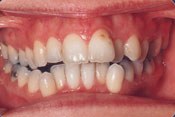
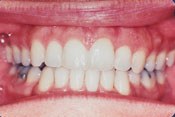
Crowding corrected with fixed appliances
A crowded upper arch brought into alignment with fixed braces during general-practice orthodontics.
General-practice orthodontics: straightening teeth, guiding jaw growth in children, and treating adults who assumed it was too late.
Orthodontics today goes well beyond “straightening teeth when all the permanent ones come in.” We are also concerned with the growth of the face, early correction, and a healthy jaw joint — because a bite that is forced into the wrong position tends to cause trouble later.
Children who show crooked teeth, prominent front teeth, a receding jaw or other facial and alignment abnormalities can be seen as early as six years old. Once the four permanent front teeth have erupted, timing matters: the window for guiding growth is not open indefinitely.
Early treatment lets us correct the alignment of the teeth and influence the growth of the jaw for a better facial appearance. Today's techniques mean fewer extractions and a more satisfactory face and smile than the extraction-heavy approach of the past.
Adults are welcome too. We have treated orthodontic patients in their sixties and seventies; with healthy gums and bone, it is probably never too late to improve alignment — often as part of cosmetic or reconstructive work.
A crowded upper arch brought into alignment with fixed braces during general-practice orthodontics.
You may call for a complimentary cursory examination and ask questions about your case. If you decide to continue, orthodontic records are taken and a consultation follows.
Orthodontics is a sequence, not a single appointment. Here is the sequence.
A complimentary look at the bite and alignment, and an honest answer about whether treatment is worth starting now, later, or not at all.
Photographs, models and X-rays as needed, then a written plan: what will move, how long it is likely to take, what it costs and what the alternatives are.
Removable appliances for some interceptive cases in children; silver or clear fixed braces for most alignment work. Adjustments are scheduled on a predictable rhythm.
Teeth have a memory. A retainer — fixed or removable — protects the result, and we explain exactly how long it needs to be worn.
Around six or seven, or sooner if you notice crowding, prominent front teeth, a crossbite, thumb-sucking that persists, or a jaw that looks uneven. An early look costs nothing and answers the question.
Usually not. Modern techniques aim to create space by other means, and extraction is recommended only when it clearly produces a better result. If it is being considered, you will hear why.
Often, yes — clear brackets and tooth-coloured wires are available. Some limited cases can be handled with removable appliances. We will tell you which options genuinely suit your case.
Teeth are tender for a few days after each adjustment, and softer food helps. It is discomfort rather than pain, and it settles quickly.
Call the office or send a request. A complimentary cursory consultation is enough to find out what, if anything, needs doing.